Author: Gabrielle Taylor
In life, our experience is broad, complex and above all, incredibly diverse. Yet despite all the differences in our lives, there are certain moments that touch every single one of us. Positive experiences like birthdays, or the first day of school or at work, are experiences many of us share, and it’s just as important to recognise the difficult experiences we have in common. Grief is one of these experiences, it’s universal and inevitable, but it remains one of the least spoken about parts of our lives.
Before we continue to explore grief, it is important that we talk about two definitions:
- Bereavement: The experience of losing a loved one.
- Grief: The thoughts and feelings that arise as a natural reaction to loss of any kind, such as the death of a loved one (bereavement), the end of a relationship or the loss of a job.
For the purpose of this blog, we will be discussing the grief that arises from bereavement. Bereavement and grief come hand in hand, bereavement being the event, grief the reaction, and although we will all experience both of these things at some point, the way we process and live through them is deeply personal.
Just as no two people have the same fingerprint, no two people experience grief in the same way. Factors such as personality, culture, relationships, previous experiences of loss, and support networks all shape how we grieve. For one person, grief may be expressed openly; for another, it may appear quiet, or internal. Neither response is ‘right’ or ‘wrong’, they are simply different reflections of the individual’s journey through loss.
Grief can fluctuate, change shape over time, and appear in unexpected ways. Because of this, it is essential that we approach others (and ourselves) with compassion rather than judgement. Many resources describe grief as a rollercoaster, capturing the unpredictable ups and downs people experience. Others compare grief to glitter, a metaphor that resonates deeply for many: once it enters your life, it never fully disappears, and it shows up again in surprising places, long after you thought you had cleaned it all away.
Whatever metaphor you connect with, the core message remains the same: grief is a journey, not a single moment in time. It evolves, shifts, and revisits us, and understanding this helps create space for patience, empathy, and genuine support, both at work and at home.
When someone experiences loss, it doesn’t stay neatly hidden at home; it is carried by people to their workplaces, shaping their behaviour. As organisations, there is a responsibility to recognise this reality, and create environments where people feel supported. At the same time, as individuals, we also hold a responsibility to ourselves. We need to pause, acknowledge our grief rather than push it down, and seek support when we need it.
Understanding grief
Individuals may be experiencing grief due to:
- The death of a loved one.
- Sudden or traumatic loss.
- Anticipatory grief when caring for someone at end of life.
- Miscarriage or pregnancy loss.
Reactions vary from sadness, to shock, difficulty focusing, disrupted sleep, irritability and numbness. There is no “right” way to grieve, which is why a one size fits all policy at work rarely works.
Supporting ourselves through grief
Before we can meaningfully support grieving colleagues, we must first understand how to support ourselves. This applies to anyone navigating bereavement while still trying to be present at work.
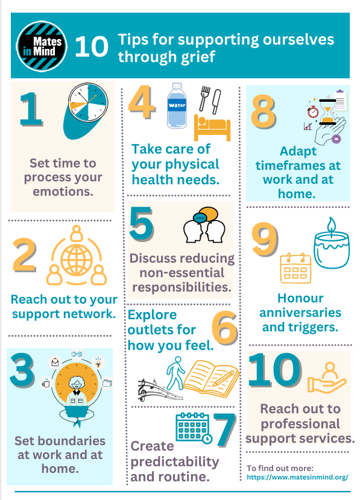
- Set time to process - Give yourself time and in some cases ‘permission’ to experience your grief.
- Reach out to your support network - You don’t have to talk about everything but letting others support you can positively impact how you feel, even if it is just sitting with you to reduce feelings of isolation.
- Set boundaries at work and at home - Reducing workload where possible, requesting flexible hours or remote working (if available), sharing or delegating household tasks and resting without guilt.
- Taking care of your physical health needs - Grief affects the body. Drink water, eat small meals and often, sleep when you need to and move your body.
- Discuss reducing non-essential responsibilities - Give yourself permission to say no, postpone, simplify responsibilities, or ask for help.
- Explore outlets for how you feel - Journaling, listening to music, creating artwork, physical activity and experiencing nature.
- Create predictability and routine - Keep mornings simple, establish regular mealtimes and maintain only what feels manageable.
- Adapt timeframes at work and at home - Extending deadlines, breaking tasks into smaller steps and taking more time for decision-making.
- Honour anniversaries and triggers - Plan ahead for difficult dates, creating small rituals/routines such as lighting a candle and let people know when days feel heavier.
- Reach out to professional support services - Employee Assistance Programmes (EAP), GPs, counsellors, bereavement support charities and helplines (please see the infographic below). There are also peer support groups, where people use their experiences to help each other.
Why organisations play a key role during grief
Supporting ourselves is important. When we are encouraged and allowed to support ourselves, typically, we return to work more grounded, more stable and with clearer capacity.
If workplace culture rewards ‘pushing through’ or presenteeism, employees won’t feel able to care for themselves. This may then lead to significantly negative consequences such as burnout, disengagement, conflict and in some cases staff turnover. But when organisations normalise vulnerability, rest and open conversation, they empower people to navigate grief with dignity, leading to:
- Individuals feeling valued and seen as people, not resources.
- Psychological safety.
- Team connectedness.
- Stabilised performance.
Self-support and organisational support are heavily connected, where one strengthens the other.
Workplace bereavement policies
One way that organisations can ensure that they are supporting individuals is through bereavement policies. A strong bereavement policy provides clarity and consistency during an incredibly overwhelming time.
Consider including:
- Clear and flexible time off.
- Recognition of unique relationships (do not limit support to ‘immediate family only’).
- Long term considerations (phased returns, adjusted deadlines).
- Access to support (EAP, Counselling etc.).
The role of managers
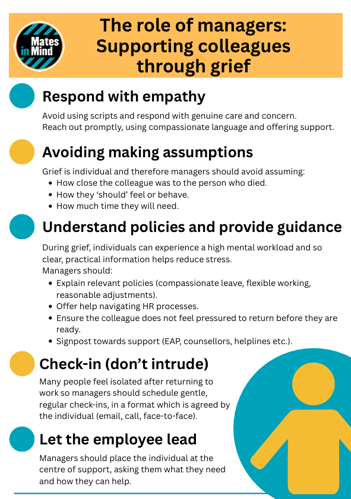
Often being the first point of contact for many people, managers also play a role in the impact an organisation has, therefore, their response to a team member experiencing grief can make an enormous difference.
Creating a compassionate culture at work
To truly support bereavement, organisations must embed compassion into culture. This means:
- Training leaders in empathetic practice.
- Creating psychologically safe environments.
- Encouraging flexibility and boundaries.
- Ensuring policies reflect human needs, not just processes.
When leaders model healthy self-support and compassion, it signals that everyone else is allowed to do the same.
Signposting Support
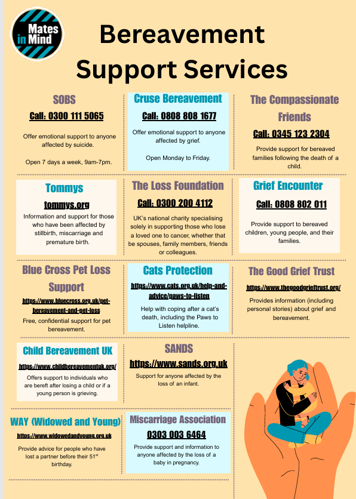
Signposting is important, for ourselves and for the people around us. These organisations have specialised services to support individuals who are experiencing grief:
- Cruse Bereavement Support: Offers support for anyone who has experienced loss.
- The Good Grief Trust: Provides information (including personal stories) about grief and bereavement.
- The Loss Foundation: Offers support to individuals who have lost someone to cancer.
- Child Bereavement UK: Offers support to individuals who are bereft after losing a child or if a young person is grieving.
- Every Mind Matters (NHS): Support for stress, anxiety, low mood, and wellbeing.
- Blue Cross Pet Loss Support: Free, confidential support for pet bereavement.
- Cats Protection Grief & Loss: Help with coping after a cat’s death, plus Paws to Listen helpline.
- Tommy’s: miscarriage information and support for both partners.
- Sands - support for anyone affected by baby loss, including dads/partners.
- Men’s Miscarriage Support (via the Miscarriage Association).
- WAY (Widowed and Young): Provide advice for people who have lost a partner before their 51st birthday.
- Samaritans: Call 116 123 for 24/7 emotional support.
- Mates in Mind: 24/7 text support - text “BEAMATE” to 85258.
- Hub of Hope: directory of local mental health support.
- CALM (Campaign Against Living Miserably): support aimed at men.
Support After Suicide
Whilst this blog does not explore grief following a death by suicide. If you are looking for guidance in this area, further support and practical advice can be found in the Post-Suicide Response Guide, which provides guidance to help individuals and organisations navigate bereavement after suicide.
Final Thoughts
Grief is part of human experience. It is unique to each of us but inevitable and when organisations recognise this and empower individuals to care for themselves as well as one another they create workplaces where people feel safe.
Supporting ourselves and supporting each other are not separate acts. They’re two sides of the same compassionate culture.
Please note: Members (formerly ‘Supporters’) can download the three infographics above from the ‘Additional Resources’ section in the portal.
Related News
The latest updates
Featured
Blog: How to support the mental wellbeing of your team in terms of suicide prevention and postvention
In this blog we look at suicide – how to build a culture of prevention in your organisation and how to support employees should a suicide occur. The blog includes two free resources to download.